Dr. Parise Carmichael-Murphy - Morehouse Students on their Civil Rights and Social Justice Study Abroad in Ireland
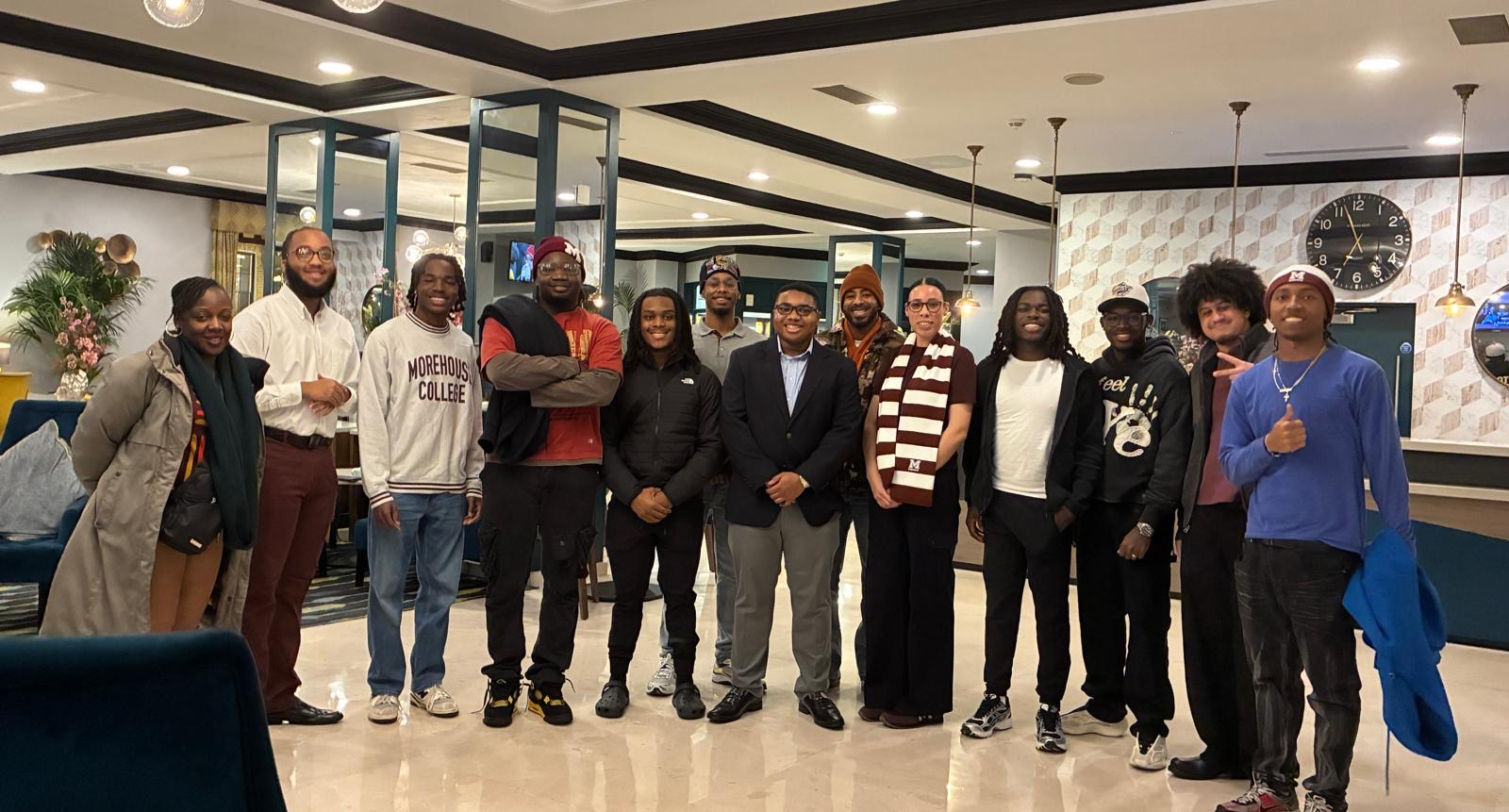
I was deeply grateful to join Morehouse students on their Civil Rights and Social Justice Study Abroad in Ireland in January 2026, led by Dr. Sinead Younge. In previous years, I have worked with Morehouse Study Abroad cohorts through the UK African Diaspora programme, leading archival workshops at the AIU RACE Centre at Manchester Central Library, focused on the history of Pan-African organising in Manchester. These shared experiences have shaped how I approach comparative histories of civil rights, colonialism, and resistance, and have strengthened my relationship with the Morehouse community.
Growing up Jamaican and Irish in Manchester has meant holding multiple cultural references, values, and histories at once. Being aware of the earlier signage “No Blacks, No Irish, No Dogs” made me acutely aware, from an early age, of the many ways people are categorised, excluded, and denied access to economic resources. That awareness has stayed with me throughout my own education, shaping how I engage with history, identity, and social justice.
A key theme throughout this Ireland trip was diaspora and emigration, which are closely connected to oppression, resistance, and agency. Irish and Black people have been displaced through colonisation, forced migration, and economic coercion; yet travel and movement have also provided ways to resist, organise, and unite. Travelling to Ireland with Morehouse students allowed me to reflect deeply on how movement and travel have influenced my own family history. It reinforced for me that travel can create spaces for connection, critical reflection, and deeper historical understanding.
Dialogue with people who share both similar and different experiences deepens our understanding of the world we live in, especially when that dialogue occurs in the places shaped by these histories. Experiencing the openness of Slieve League cliffs alongside the restrictive architecture of the Ballyshannon Workhouse made the history feel particularly emotive.
I valued the opportunity for student-led discussion, where we addressed the tensions that come with comparison. A recurring topic that kept coming up was how to compare struggles without creating a hierarchy of oppression. Rather than pursuing that line of thinking, we explored the idea that civil rights movements in the United States and Ireland are interconnected but distinct, shaped by different historical, political, and social conditions. This approach allowed us to consider how British colonialism, displacement, plantation economies, and systems of exploitation manifested differently for African American and Irish communities, while still producing recognisable patterns of inequality today.
Another important theme for the group was the notion of peace. We asked difficult questions: Do younger generations have an obligation to maintain peace agreements shaped by their elders? How do ideas about ‘keeping’ or ‘breaching’ the peace operate in contemporary Ireland and the United States? These conversations encouraged us to consider who gets to define peace and how it can offer both protection and precarity, depending on who defines it and who is asked to live within its limits.
During the trip, we looked at common strategies employed in both the Irish and American civil rights campaigns, such as marches, boycotts, and community organising, as well as various ways that people were categorised and controlled based on their gender, race, religion, or class. Though the parallels are imperfect, similarities in Jim Crow and Penal Laws, gerrymandering, housing restrictions, and barriers to generational wealth were hard to ignore. These comparisons encouraged careful thinking about how systemic oppression reverberates across generations.
Before the Civil Rights and Social Justice Study Abroad programme in Ireland, much of my thinking about civil rights focused on direct parallels between Britain and the United States, such as the Bristol Bus Boycott of 1963. This trip expanded my outlook, inspiring me to think more expansively about freedom from British colonialism and the ways that many fights for identity, language, culture, education, and housing influence one another across time and space. I am deeply thankful to the Andrew Young Centre for Global Leadership for the invitation to support the Civil Rights and Social Justice Study Abroad in Ireland. I return to Manchester with a renewed commitment to exploring how Black and Irish histories intersect and how solidarity can be built in practice. I look forward to continuing this work and welcoming more Morehouse students to Manchester for the African Diaspora in the UK Study Abroad trip in March 2026.